Celebration of the 70th Anniversary of the 1956 Hungarian Revolution
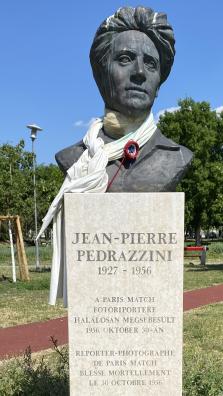
The 1956 Hungarian Revolution revealed to the free world the oppressive nature of communist regimes. The sight of insurgents confronting Soviet tanks shook global public opinion.
The Hungarian historians invited to the roundtable, Gergely Fejérdy and Gusztáv Kecskés D., are specialists in Franco-Hungarian relations and have published numerous works on the 1956 revolution. Catherine Horel, who will moderate the discussion, is a historian and specialist in the history of Central Europe in France.
We wish to combine the commemoration of the Hungarian Revolution with the 100th anniversary of the birth of Lajos Nyéki, a Hungarian linguist and poet who was a professor at INALCO from 1979 to 1994.
Lajos Nyéki went into exile in France in 1956, after the revolution was crushed.
Featuring:
- Catherine Horel, research director at the CNRS, Paris, external member of the Hungarian Academy of Sciences
- Gergely Fejérdy, Deputy Director of the Otto von Habsburg Foundation, lecturer and researcher at Péter Pázmány Catholic University, Budapest
- Gusztáv Kecskés D., research director at the Institute of History, University of Budapest (ELTE)
- Thomas Szende, professor emeritus at INALCO, Paris
- Kati Jutteau, lecturer in Hungarian history, INALCO, Paris