Chasing the "World Majority": Russia's Information, Cultural, and Religious Influence in the "Global South"
This event is part of the UKRI-funded project “War and Order: Russian Communications in the Global South” and is organised within the Inalco Chair on “Influence and Counter-Influence Strategies in Digital Environments”, which received the support of the French National Research Agency (ANR) and the French Ministry of Higher Education and Research (MESR).
Speakers
- Precious Chatterje-Doody (Senior Lecturer in Politics and International Studies, Open University, UK)
- Daniel Stockemer (Full Professor and the Konrad Adenauer Research Chair in Empirical Democracy Studies, University of Ottawa, Canada)
- Gulnaz Sibgatullina (Assistant Professor of Illiberal Regimes, University of Amsterdam, Netherlands)
- Maxime Audinet (Assistant Professor and holder of the Research Chair in Influence and Counter-Influence Strategies in Digital Environments, INALCO, France)
Summary
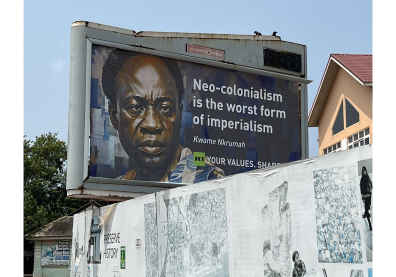
This conference explores how Russian actors deploy information, cultural, and religious resources and networks in several "Global South" countries to produce ideational convergence and shape narratives on the war in Ukraine and the international order. It brings together an international team of scholars investigating the role of the Russian Orthodox Church in East Africa and the promotion of Russian strategic narratives in two other BRICS+ members (India and South Africa). The conference examines how illiberal, anti-colonial, and "pro-Russian" ideas circulate, adapt to local contexts, and are received by targeted audiences.
This event is part of the UKRI-funded project “War and Order: Russian Communications in the Global South” and is organised within the Inalco Chair on “Influence and Counter-Influence Strategies in Digital Environments”, which received the support of the French National Research Agency (ANR) and the French Ministry of Higher Education and Research (MESR). It also forms part of the Observatory of Contemporary Russia conference series of Inalco’s Center for European and Eurasian Studies (CREE), and benefited from the partnership of the Paris branch of the Illiberal Studies Program (ILLSP) hosted at Inalco.
The Observatory of Contemporary Russia
The Observatory of Contemporary Russia (co-hosted by Maxime Audinet, Sylvia Chassaing, Laurent Coumel and Julien Vercueil) monitors current events in this country, bringing in specialists in the humanities and social sciences, from literature to economics, via history, geography, political science, sociology, anthropology and linguistics, in a format open to a wide audience: round tables, book presentations, film screenings and debates. It aspires to shed light on contemporary issues linked to conflicts - the war against Ukraine among them - crises and transformations of this state born of the demise of the Soviet Union in 1991.
The Chair on "Influence and Counter-Influence Strategies in Digital Environments"
Anchored in international relations, area studies and information and communication sciences, the Chair aims to expand current scholarship on the influence and counter-influence strategies of liberal democracies and “informational autocracies.” Working closely with the DECRIPT project, it supports Inalco’s internationalization strategy by helping position the institution among the leading academic centers on these issues in France and Europe.
While Russia serves as the chair’s primary—though not exclusive—case study, its research is structured around three main themes:
- Ethnography of an influence strategy: actors, practices and projection Russia’s ecosystem of influence;
- Foreign policy and strategic narratives: production, circulation, and reception;
- Securitising influence: counter-influence public policies and responses to foreign information manipulation and interference (FIMI) in Europe.
In a context where access to many research fields —including Russia—is increasingly restricted, the Chair embraces the “digital turn” in the social sciences. It promotes the integration of open-source investigative methods (OSINT) into the methodological toolkit of area studies, encouraging innovative combinations of ethnographic and digital research approaches.
Organisation
- Maxime Audinet (CREE, Inalco)