
The Communist defeat at Kinmen (25–27 October 1949): a new interpretation of the year 1949 in China?
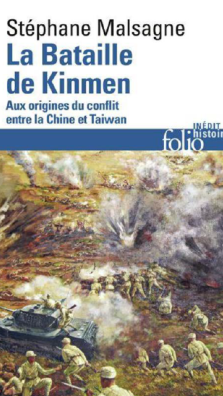
Round-table discussion with:
Stéphane Malsagne, Professor of History, Paris I
Chloé Froissart, Professor of Political Science, Department of Chinese Studies, Inalco-Ifrae
Alexandre Gandil, postdoctoral researcher, Centre for Geopolitics, University of Cambridge
David Serfass, Senior Lecturer in History, Department of Chinese Studies, INALCO-IFRAE
Abstract:
On 1 October 1949, Mao Zedong proclaimed the establishment of the People’s Republic of China. His priority? To reclaim Taiwan, which he felt had been severed from the mainland, for this new state. The People’s Liberation Army, with the limited support of Stalin, prepared an offensive to unify the country and conquer the island, where Chiang Kai-shek’s Nationalists had taken refuge. It was on Kinmen, a small archipelago in the Strait of Formosa, that the Communists and Nationalists engaged in fierce fighting from 25 to 27 October 1949. Marking a turning point in the civil war, these clashes resulted in Mao’s greatest military defeat and the first victory for the Republic of China, whose government has since remained in Taiwan. It is to this brief but no less decisive Battle of Kinmen that Stéphane Malsagne devotes a detailed study here, which both fills the gaps in current historiography and recounts the emergence and resistance of a people who are still fighting for their peace and freedom.
Organiser: Chloé Froissart View e-mail