DÉCRIPT in dialogue | The Once and Future World Order
The Fondation Maison des sciences de l'homme (FMSH) and the program DÉCRIPT, led by Inalco for a consortium of fifteen institutions, are inaugurating a new biannual appointment devoted to the great voices of international research.
" DÉCRIPT in dialogue" extends the spirit of the "Livres en dialogue" cycle, devoted to works published and distributed by the FMSH, by opening it up to international debates. Each sequence, hosted by a journalist, will feature a researcher from the global academic scene and one of his or her major works to question the frames of reference that shape our reading of the world.
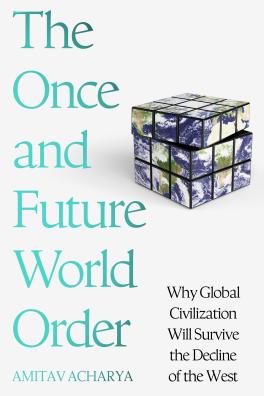
The first meeting will take place on January 22, 2026 and will welcome political scientist Amitav Acharya, invited to present his book The Once and Future World Order. Why Global Civilization Will Survive the Decline of the West, in a conversation moderated by Catherine Porter, international correspondent for The New York Times. A strong opening for a cycle placed under the sign of the circulation of ideas.
About the book
Since the dawn of the XXIᵉ century, the West has been in crisis. Social tensions, political polarization and the rise of other great powers - particularly China - threaten to unravel the current Western-dominated world order. Many fear this could lead to global chaos. But this is a Western illusion.
Touring five thousand years of global history, political scientist Amitav Acharya reveals that forms of international order existed long before the rise of the West. From ancient Sumer to the present day, via India, Greece, Mesoamerica, medieval caliphates and Eurasian empires, Professor Acharya shows that humanitarian values, economic interdependence and rules of conduct between states have emerged in every corner of the world over the millennia.
History suggests that order will endure, even if the West retreats. Instead of fearing the future, the West should learn from the past and cooperate with the rest of the world to build a more equitable order.
About the speakers
Amitav Acharya is the UNESCO Chair in Transnational Challenges and Governance and Distinguished Professor at the School of International Service at American University in Washington, D.C. An award-winning author, he has published, among other works, The Making of Global International Relations, with Barry Buzan (Cambridge University Press, 2019) and The End of American World Order (Polity Press, 2014). Born in India, he has lived and worked in Singapore, Canada, the United Kingdom, China, and the United States.
Catherine Porter is an international correspondent for The New York Times based in Paris. Since 2022, she has covered political and social affairs in France. A foreign correspondent for more than fourteen years, she is widely recognized for her expertise on Haiti, which she has closely reported on since the devastating earthquake in 2010. She is the author of A Girl Named Lovely (Simon & Schuster, 2019) and was awarded the George Polk Award in 2022 and the Hillman Prize in 2023 for her investigative reporting on Haiti.
About DECRIPT
From the "initiative for a global civilization" advanced by China to the "civilization of civilizations" promoted by Russia, via the US State Department's call to "seek civilizational allies in Europe", reference to the notion of civilization structures many political discourses and permeates collective imaginations. What representations of the world underpin the civilizational narratives conveyed by a growing number of international players? Who articulates them, and what mechanisms govern their production, dissemination or contestation? How do they intertwine with conflict dynamics and reconfigure both the analysis of global issues, models of their governance and, more broadly, the notion of universal norms?
The DÉCRIPT program (Dispositif d'Étude des Crises et des Récits civilisationnels par la Pluridisciplinarité et les Terrains), led by Inalco with a consortium of fifteen partners and supported by France 2030, aims to shed light on these issues by crossing areal and global studies. Drawing on the humanities, social sciences and data analysis, DÉCRIPT produces original, empirically grounded research. It aims to inform public action and disseminate its findings widely, in order to contribute to a critical understanding of the interactions between civilizational narratives and contemporary crises.