Inaugural lecture of the ‘Buddhism and Poetry’ series 2026–2028
As part of the CEIB’s 2026 academic year and the launch of a second series of lectures in partnership with the Glorisun Foundation, the Centre for Interdisciplinary Studies on Buddhism will welcome Jean-Noël Robert (Professor Emeritus, Collège de France) and Edward Kamens (Sumitomo Professor Emeritus, Yale University).
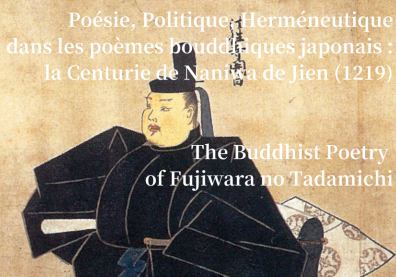
To mark the start of this new three-year series, focusing on the theme of Buddhism and Poetry, Professor Jean-Noël Robert will deliver a lecture entitled: ‘Poetry, Politics and Hermeneutics in Japanese Buddhist Poems: Jien’s *Naniwa Hundred* (1219)’, followed by a lecture by Professor Edward Kamens: ‘The Buddhist Poetry of Fujiwara no Tadamichi’. The discussion will be led by Professor Matthias Hayek.
Abstract
Poetry, Politics and Hermeneutics in Japanese Buddhist Poems: Jien’s *Naniwa Centuria* (1219)
Despite the ancient warning issued by the Buddha himself against setting his teachings to verse (chandas)—a warning endlessly repeated in the Sino-Japanese world, which sought to keep religious figures away from the ‘unreasonable remarks ’ 狂言綺語 of poetry, Japanese poets have, over nearly a millennium, developed and cultivated a particular sub-genre of classical poetry, waka, which can be translated simply as ‘poems on Buddhism ’ 釋教歌, or, owing to the ambiguity of the first character, as ‘hermeneutic poems’. The key figure in the development of this genre was Jien 慈圓 (1155–1225), a prolific poet and, at the same time, patriarch of the powerful Tendai school. Born into a distinguished family with close ties to Emperor Go-Toba, he found himself at the centre of the political upheavals that engulfed Japan at the end of the 12th century. His involvement in the events of his time led him to set down in his *Modest Views* (*Gukan-shō*), written in Japanese, his conception of Japanese history as a dialectic between the way of the sovereign and the way of the Dharma. One of his later collections of poetry, the ‘Naniwa Hundred Poems’ (難波百首), is an offering of one hundred poems to Shitennō-ji Temple (四天王寺) in Osaka Bay, founded in the 7th century by Prince Shōtoku (聖徳), himself regarded as the model of a sovereign uniting the two paths. The poems in the collection, imbued with Amida Buddhist piety, are intended to be placed alternately under each of the two truths: the conventional or phenomenal truth (俗諦) and the absolute truth (真諦), one of the central tenets of the Tendai school. At the same time, they echo the ideas on history set out in *Modest Views*. This collection of one hundred poems must therefore be read in three dimensions: as a devout offering to the Amida temple, as a description of how the Buddhist Dharma fits into worldly politics, and as a dialectical synthesis of the two truths in the name of a higher understanding which is the third truth, or Middle Way (中道). Drawing on an excellent annotated edition of this text published a few years ago in Japan, we shall attempt to shed light on this threefold relationship as an example of the reflective richness of classical Japanese Buddhist poetry.
Guests
Jean-Noël Robert is Professor Emeritus at the Collège de France, where he held the Chair of Philology of Japanese Civilisation from 2011 to 2022, and in the Department of Religious Studies at the École pratique des hautes études. His work has focused in particular on the history of the doctrines of the Tendai school of Buddhism. Through his research into the development of Japanese Buddhist poetry, he has broadened his field to encompass the entire range of linguistic relations between Classical Chinese and Japanese, as mediated by Buddhist thought. His research has led him, drawing on the Sino-Japanese model, to develop the concept of ‘hieroglossia’, which aims to describe the evolution of cultural and linguistic spheres in which the role played by the religious factor through translation is predominant.
Edward Kamens is Sumitomo Professor Emeritus of Japanese Studies at Yale University. His major publications include *The Three Treasures: A Revised and Illustrated Study and Translation of Minamoto no Tamenori’s Sanbōe* (2023); *Waka and Things, Waka as Things* (2017); *Utamakura, Allusion and Intertextuality in Traditional Japanese Poetry* (2007); and The Buddhist Poetry of the Great Kamo Priestess: Daisai’in Senshi and Hosshin wakashū (1991), as well as articles and essays on The Tale of Genji, Buddhist poetry, calligraphy albums (tekagami) and intermediality in Japanese culture.