In the footsteps of Johannes Aavik: a competition for the creation of new words in French and Finnish
Menu Campus life
The Aavik Museum in Kuressaare, in partnership with the Estonian Department at Inalco, is organising a competition to create new words in French and Finnish inspired by the work of Johannes Aavik. What words could we create today in French using Aavik’s methods? You can submit your entries before 28 October. Prizes include a stay on the island of Saaremaa in Aavik’s birthplace.
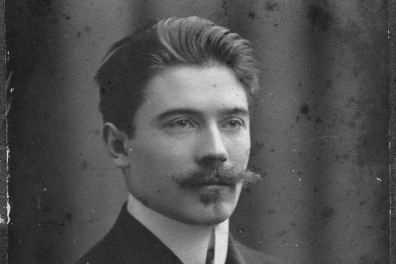
Johannes Aavik (1880–1973) was one of the leading figures in the modernisation of the Estonian language. Convinced that Estonian should become a language of culture capable of rivalling the major European languages, he undertook an ambitious project of linguistic renewal (keeleuuendus) in the early decades of the 20th century. His aim was not only to enrich the vocabulary, but also to expand the language’s stylistic possibilities and expressiveness. To this end, he considered it legitimate to intervene consciously and creatively in its development.
To enrich the Estonian lexicon with new words that he considered more aesthetic or more effective, Aavik employed three main methods:
- He introduced a large number of loanwords, often adapted from Finnish, but also from French or other European languages. Thus, the Estonian words hetk, kogemus and kiindumus are derived from the Finnish words hetki, kokemus and kiintymys.
- He modified Estonian or foreign words in a more or less arbitrary manner. For example, from the French embrasser, he coined the Estonian word embama ; by combining the Finnish words suloinen ‘charming’ and kaunis ‘beautiful’, he created the Estonian word sulnis ‘delightful’ ; and by modifying the Estonian word tõsi ‘true’, he formed tõik ‘a fact’.
- He created entirely artificial words by freely combining phonemes. The best-known word among those he created using this method is veenma ‘to convince’, which he selected in 1914 from 297 combinations with the same phonological structure.
In autumn 2026, the Aavik Museum in Kuressaare (Estonia) is organising a lexical creation competition in French and Finnish, in collaboration with Inalco, the University of Helsinki, the Finnish Institute in Tallinn and the French Institute in Estonia, and with the support of the Finnish-Estonian Cultural Fund.
Just as Johannes Aavik drew on Finnish and French to enrich the Estonian language, participants are invited to take inspiration from Estonian and Aavik’s methods of lexical creation to enrich the French and Finnish languages.
Entries will be judged by a Finnish jury (Päivi Kuusela, Heidi Iivari, Reijo Roos) and a French jury (Antoine Chalvin, Martin Carayol, Guillaume Gibert). The creators of the most successful neologisms will be offered language and culture-themed stays for two people in L’Isle-Jourdain (France), Tuusula (Finland) and Kuressaare (Saaremaa), as well as one of the best summer language immersion stays with a host family to learn Estonian in Estonia (Saaremaa). The words selected by the juries will travel to Paris, Helsinki, Tuusula, Tartu, Tallinn and Kuressaare, in the form of a temporary travelling exhibition and an intervention in the urban space.
Proposals must be submitted by 28 October 2026 at the latest.