IMAS Master's inaugural conference
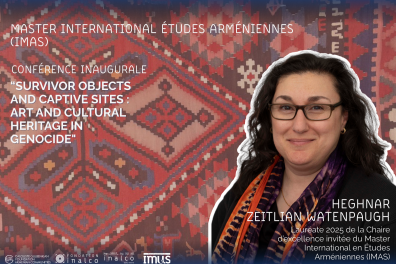
Synospis from the conference
What happened to the cultural heritage of the communities destroyed during the genocide of the Armenians of the Ottoman Empire? Armenian cultural sites, particularly religious sites, were destroyed, reassigned, appropriated, sold or transferred. Most of them were detached from their connection with the surviving Armenian communities.
Artefacts - especially sacred objects - were also transferred, looted or moved. Some eventually found their way into museums in Europe or North America, where they are now appreciated for their aesthetic qualities.
This lecture proposes to reflect on the near-simultaneity of these two processes - destruction and transformation into works of art - and to examine their multiple implications, as well as what this heralds for art history and for the museum institution in the XXIᵉ century, in the context of the Armenian Genocide.
Commemorating the Armenian Genocide
"Genocide is defined as acts committed "with the intent to destroy, in whole or in part, a national, ethnic, racial or religious group as such". As researchers working on genocide and culture have shown, the genocidal process is not limited to the physical extinction of the targeted community: it also extends to the erasure, appropriation or transfer of the cultural property of that community.
The history of the Armenian Genocide and its aftermath illustrates this particularly well. During the genocide and in the years that followed, sites associated with Armenian culture, particularly religious sites, were destroyed, reassigned, appropriated, sold or transferred. Some of them then became part of the cultural heritage integrated into the state heritage, while being cut off from any links with the Armenian communities that still existed.
Objects - especially sacred ones - were also transferred, looted or moved. Some ended up in museums far from the Armenian homeland. In complex ways, these sites and objects thus acquired "a second life as heritage"and as works of art.
This lecture examines the implications of the articulation between the process of genocide and the extinction of a community, and the processes by which sites become heritage and objects become museum pieces. To theorize this transformation, I draw on the notion of "captive sites" developed by Peter Balakian, which refers to architectural sites and religious buildings left in place but separated from their original community, as well as my own concept of "survivor objects", applied to transportable objects looted or displaced as a result of genocide and population displacement.
This conference thus proposes to reflect on the near-simultaneity of these two processes - the extinction of a community and the transformation of its material traces into art or heritage - and to examine their multiple implications, as well as what this heralds for art history and for the museum institution in the XXIᵉ century. "
The IMAS Master
In this specific context, Inalco has designed in 2021 the Master IMAS (International Master in Armenian Studies). Aimed at international Armenian speakers from or interacting with the diaspora, this program provides teaching in Western Armenian, covering a very wide range of disciplines in the humanities and social sciences.
Entirely online,in a synchronous and asynchronous format that adapts to its international audience, it is certified by a diploma at the end of the course. Between 2021 and 2025, the IMAS Master's program enrolled 67 students; 50 graduates are expected by 2026. Since its launch, it has thus enabled students from 17 countries to enter a high-level training program in Western Armenian.
Inalco is today the only higher education institution in the world, outside Armenia, to offercomplete training in Western and Eastern Armenian from beginner to doctoral level.