Jean-Marc Lieberherr Monnet's contribution to the Jean Monnet "EU-LACE" module
Menu International
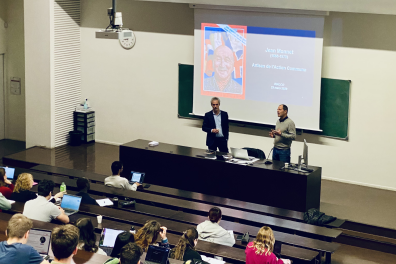
In connection with the Jean Monnet EU-LACE project, led by Inalco, students in the 3rde year of Bachelor's degrees in Inalco's International Relations stream and Europe department had the pleasure, on March 25, 2026, of listening to and exchanging views with Jean-Marc Lieberherr Monnet, President of the Institut Jean Monnet. The subject of the discussion was "The topicality of Jean Monnet's thought and thinking in the 21st century". It was organized as part of the lecture course on "European construction: history and institutions", taught by Dr Frédéric Allemand. Rather than recalling the multiple lives of his grandfather, Mr. Lieberherr emphasized the constancy of Jean Monnet's thinking and method for dealing with and resolving the disorders of international relations: taking advantage of necessity to overcome the constraints of national sovereignty. Having joined the family business at an early age, Jean Monnet was a man of encounters, exchanges and dialogues. His professional experience had taught him to set aside grand theories and systems in favor of concrete action based on simple facts. At the outbreak of the 1st World War, France and the United Kingdom, although allies, were competing to buy Canadian wheat, resulting in higher prices for both. Jean Monnet advocated pooling purchases and optimizing logistics, with shared management. National sovereignty was outdated in law, but strengthened in practice. This same spirit guided him when it came to confronting Nazi Germany's military aggression against France. As Jean-Marc Lieberherr reminds us, in early June 1940, Jean Monnet defended to the British government the principle of a Franco-English union: a single government, a single parliament, a single army. The project failed by a matter of hours: Pétain suspended the republican order and declared his acceptance of the armistice. Three years later, in Algiers, Monnet anticipated the end of the war and imagined the conditions for restoring peace. This was not to be a repeat of 1918, a peace against Germany. The peace he advocated required that states not be reconstituted on the basis of national sovereignty. Two conditions were identified: the re-establishment of democracy in Europe, and the economic and political organization of a "European entity". On May 9, 1950, Robert Schuman made public Monnet's idea of founding the Europe of peace around the pooling of Franco-German coal and steel production. In his exchange with the students, Jean-Marc Lieberherr reminded them that while the state of necessity leaves no room for hesitation in taking action, it is up to political leaders, like Robert Schuman, to bring about change.
For more information on the EU-LACE project, visit the following page.
Funded by the European Union. The views and opinions expressed are those of the authors and do not necessarily reflect those of the European Union or the French National Erasmus+ Agency. They do not engage the responsibility of the European Union or the granting authority.