
A look back at the 11th EUniWell Rectors’ Assembly, hosted in Paris by Inalco
This meeting marks a new stage in this partnership, which began in 2023, during which Inalco has actively contributed to the alliance’s ambitions, notably by leading the working group on multilingualism and multiculturalism.
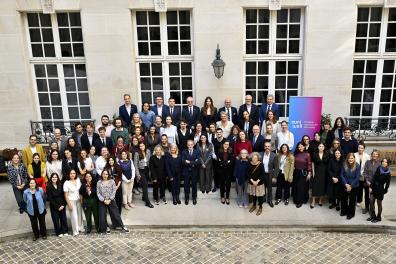
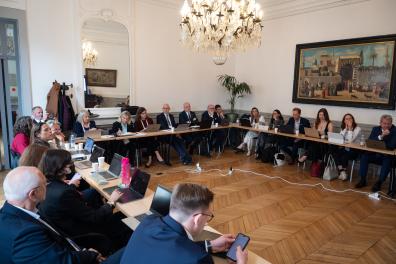
Held in Paris for the first time this year, the EUniWell Rectors’ Assembly provides an opportunity to reflect on Inalco’s contributions since joining the alliance in 2023, as well as on the opportunities the alliance offers to our entire community.
Inalco’s expertise in languages and cultures has enriched the alliance’s collective thinking. The working group on multilingualism (Arena 4: Culture, Multilingualism and Well-Being), led by Inalco, has enabled the creation of shared resources and the development of collaborative training and research projects centred on issues relating to well-being and multilingualism: LiME (Lived Multilingualism within EUniWell), LANG-PACT (Language for Well-Being), LangCare (Multilingual Patient Safety). The collaboration arising from this “Arena” also gave rise to the project Erasmus+ LULaC (Lesser-Used Languages Classroom).
EUniWell has opened up new opportunities for mobility, enriched the range of courses on offer and strengthened cooperation between students, staff and researchers at member institutions. Short-term mobility programmes have enabled students and staff to discover other academic environments, whilst the joint course catalogue has expanded opportunities for distance learning. Collaboration with partner institutions has also fostered the joint development of study programmes and opened up new opportunities for researchers, bringing their work together around shared challenges relating to wellbeing.
This collaboration is underpinned by a shared conviction: languages are an essential vehicle for wellbeing, inclusion and mutual understanding. By promoting linguistic and cultural diversity, Inalco is fully committed to EUniWell’s mission: to improve wellbeing within the European academic community and beyond. Inalco intends to continue contributing to the alliance’s projects in order to develop new training programmes, mobility schemes and collaborative initiatives for the benefit of its entire community, whilst promoting its expertise across Europe.
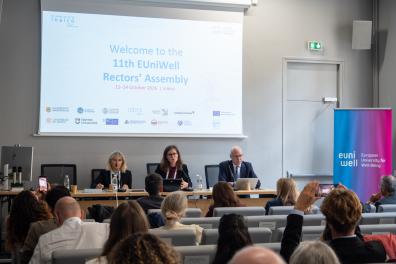
A public session dedicated to multilingualism
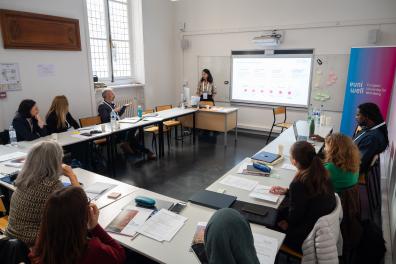
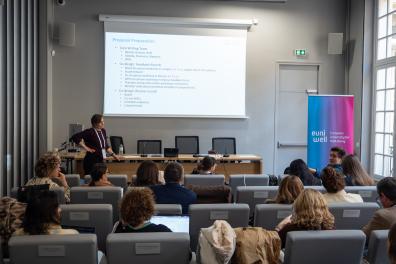
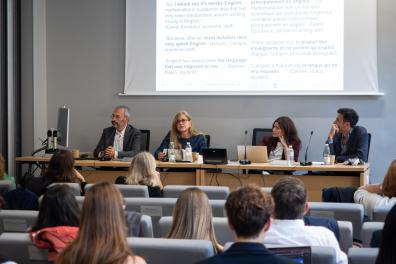
The public session of the Rectors’ Assembly, entitled “Multilingualism in a Multipolar World”, explored the links between multilingualism and well-being through a series of presentations, before concluding with a round-table discussion bringing together rectors and students. These discussions provided an opportunity to reflect on how our universities can build bridges between cultures, bring different perspectives closer together and promote wellbeing within the EUniWell community.
As the venue for the Assembly had to be changed due to the ongoing national protests by secondary school and university students, Delphine Allès, acting director of Inalco, called on the alliance to view this situation both as a call for reflection and as a logistical challenge:
These campaigns urge us to recognise that young people’s wellbeing is an essential component of a society’s wellbeing, and that it depends on structural conditions: conditions relating to their studies and daily lives, prospects for the future, and the ability to exercise genuine autonomy in collective decision-making, particularly decisions that span several generations and shape the future. Even where these concerns do not fall directly within our remit, EUniWell, as an alliance of European universities, can play a role in giving them greater visibility.
Delphine Allès
Rima Sleiman, Vice-President for Research at Inalco, went on to emphasise multilingualism, major research programmes and support for researchers setting up joint projects. Drawing on Inalco’s research in languages and regional studies, she demonstrated how EUniWell can transform its collaborations into a sustainable European research strategy.
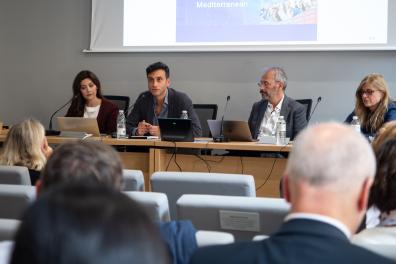
Andreas Guidi, senior lecturer at Inalco and EUniWell Champion 2025–2026, championed the value of area studies and modern history. A Mediterranean perspective – linked to Europe but not limited to it – is essential for understanding the social dynamics associated with well-being: migration, social protection, peace and climate change. He also called for greater visibility for the humanities within the EUniWell agenda.
Julie A. Panagiotopoulou (University of Cologne) and Theodoros Marinis (University of Konstanz) presented the initial findings from the surveys and interviews conducted as part of the LIME project (LIved Multilingualism within EUniWell). This collaborative project, in which INALCO is participating, maps the language practices and needs of students and staff at member universities in order to lay the foundations for a common language policy across the alliance.
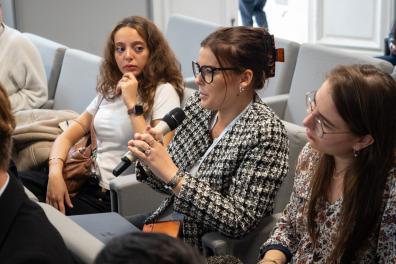
To conclude this session, Delphine Allès, Rosa M. Crujeiras Casais (University of Santiago de Compostela) and Rafal Krenke (Warsaw Medical University) discussed with Gaida Lefeuvre Mendoza, Chief Student Officer at EUniWell, and members of the Student Board, how best to support student-led initiatives and translate their suggestions into concrete actions.