Ukrainian Studies in France Today: A Growing and Much-Needed Field of Expertise

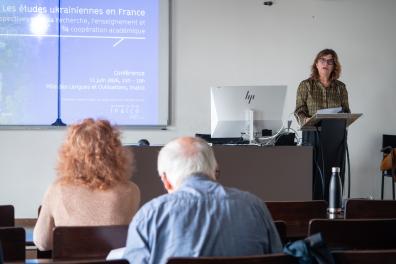
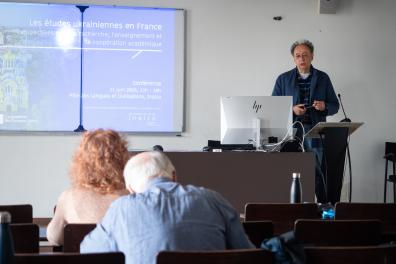
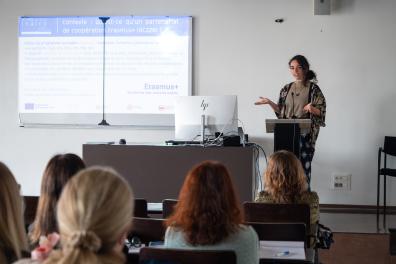
Organised within the framework of the Erasmus+ Cooperation Partnership EUkraine Forum, the conference aimed to present the project’s results and place them in the broader context of the current state of Ukrainian Studies in France. The discussions showed that this field is experiencing unprecedented momentum, driven both by growing interest in Ukraine and by the need for expertise grounded in the country’s contemporary realities. They also highlighted the role that Erasmus+ cooperation partnerships can play in advancing Ukrainian Studies by fostering the co-creation and dissemination of awareness-raising and training resources, as well as the integration of Ukrainian partners into European academic networks.
Understanding Contemporary Ukraine
In his keynote address, Hugues Mingarelli, former Ambassador of the European Union to Ukraine, stressed the importance of developing a deeper understanding of contemporary Ukraine in France. Beyond issues directly related to the war, he emphasised the need to promote a more accurate image of the country and a better understanding of its political, economic and social developments. Such knowledge is also essential for assessing the strategic implications of Ukraine’s future accession to the European Union.
These reflections resonated with presentations on the teaching of Ukrainian language, literature and history at Inalco University, Sorbonne University and Lumière Lyon 2 University. Speakers demonstrated how Ukrainian Studies are gradually becoming more established within the French higher education landscape, while also highlighting challenges such as limited resources and the fragmentation of expertise.
Building Networks of Expertise
The discussions also explored the place of Ukraine within area studies and the social sciences. Anna Colin Lebedev, Senior Lecturer at the University Paris Nanterre, presented the Observatory of Contemporary Ukraine, whose objective is to structure a French-speaking network of academic experts on Ukraine and to provide evidence-based input for public debate and policymaking. Her presentation highlighted the importance of dialogue between academic research and society at a time when Ukraine-related issues occupy an increasingly prominent place in European affairs.
Academic cooperation also featured prominently throughout the conference, notably through the presentation of the partnership between Chernivtsi University and the University of Lorraine, which provided a concrete example of collaboration between French and Ukrainian higher education institutions.
Teaching Ukrainian in France
The third panel focused on the role of institutions in promoting Ukrainian language and culture. Mykola Shabinski and Liliia Dorundiak, both special advisers to the Ministry of Education in the Île-de-France region, presented initiatives supporting the teaching of Ukrainian to Ukrainian refugee pupils in France, alongside efforts to expand opportunities for French students to learn the language.
These projects illustrate the gradual emergence of a more structured educational offer around Ukrainian within the French school system and demonstrate the potential synergies between different sectors of education.
Producing New Knowledge on Ukraine
The research panel highlighted the growing importance of Ukrainian-language sources in academic work. Julien Dubois, PhD student at the Interdisciplinary Center for Strategic Studies (Sorbonne Nouvelle University), emphasised the need for French strategic studies to engage more extensively with Ukrainian scholarly literature and primary sources in order to better understand the specific features of Ukrainian foreign and security policy decision-making processes.
Drawing on her historical research, Clarisse Brossard, PhD student at Inalco University, demonstrated the largely unexplored nature of many Ukrainian archival and documentary sources and the importance of studying them in order to renew our understanding of Ukraine’s history.
Together, these presentations underscored a key message that emerged throughout the day: the development of Ukrainian Studies depends not only on teaching language and culture, but also on improved access to Ukrainian sources and on the training of specialists capable of working with them.
A European Reflection on the Future of Ukrainian Studies
By bringing together specialists in language, literature, history, social sciences and international relations, the conference provided a comprehensive overview of Ukrainian Studies in France. It also highlighted the vitality of initiatives led by universities, academic institutions and cooperation networks, while pointing to the structural challenges that remain in consolidating this field over the long term.
Organised as part of the Erasmus+ EUkraine Forum project, the event represented an important milestone in the reflection carried out since 2024 by the project partners on the future of Ukrainian Studies in Europe. The outcomes of this work have resulted in a set of recommendations addressed to universities and European decision-makers, aimed at supporting the development of teaching, research and academic cooperation related to Ukraine.
The recommendations, together with all resources produced within the project, are available here: Strengthening Ukrainian Studies in Europe: The EUkraine Forum Consortium Publishes Its Final Recommendations