
Migration and heritage: Chinese in Europe and Brazilians in Japan
The MigrAsie seminar is organized by the Migrations in Asia, Asian Migrations team of IFRAE (French Institute for Research on East Asia) in cooperation with CERI (Sciences Po Paris) and Héritages (Cergy Paris University). The seminar is a meeting place around questions of interregional mobility within the East Asia region, and from East Asia to the rest of the world, in particular towards Europe.. Seminar leaders: Hui-yeon Kim (IFRAE), Hélène Le Bail (CERI), Juan DU (Héritages), Isabelle Konuma (IFRAE)
Pauline Cherrier (MCF, IrAsia, Aix-Marseille University)
An attempt to highlight Brazilian immigration in Japan? The case of the Oizumi museum
In a Japan still reluctant to officially open its doors to immigration, foreign presence is mostly mediatized in negative terms. Some actors and spaces nevertheless try to produce more rewarding counter-discourses allowing a better understanding of the complexity of immigrants' experience. We propose in this communication to look at the discourses produced within the Brazilian immigration museum opened in 2018 in the small town of Oizumi. We will analyze the issues, challenges and contradictions that this small museum reveals with multiple functions both community and tourist.
Juan Du (MCF, Héritages – Cergy Paris Université)
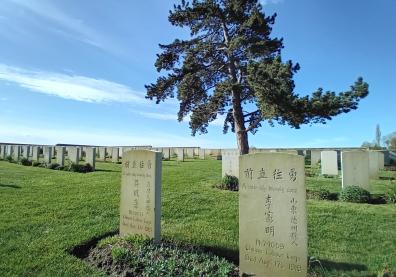
The Chinese workers of the First World War in France: heritage practices and memorial issues of recognition in national history
In 1916, in order to compensate for the lack of manpower caused by the war, the British and French governments decided to recruit, under contract, more than 140,000 Chinese workers. This story, although documented by some historians, remains largely unknown in the French national narrative. However, since the late 1980s, Chinese immigrants living in France have been visiting Picardy on the occasion of the Qingming festival to pay tribute to the Chinese workers who died for France. Based on participant observations and interviews, as well as analyses of speeches made during commemorative ceremonies, this communication aims to reconstruct the history of commemoration practices. It examines the diversity of actors involved and questions the contemporary springs of the reactivation of this marginalized memory.
Discussion: Évelyne Ribert (research officer, IIAC, CNRS-EHESS)
Organizer of the session : Isabelle Konuma View e-mail