Pastoralism Days
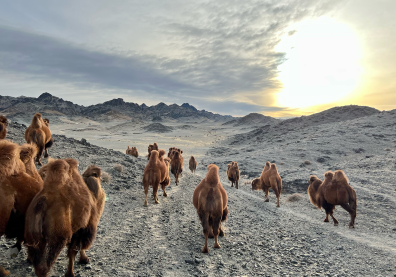
The world is home to a wide variety of domestic breeds on which a large population depends, but these breeds are currently facing numerous threats, leading among other things to an erosion of their diversity. With this in mind, the PASTODIV project, funded by the French National Research Agency (ANR), aims to analyze the dynamics of domestic animal diversity resulting from the conceptions and practices of local breeders. Focusing on the herd level, the project combines an emic perspective on domestic animal diversity, conceptual models integrating social organization in the study of agrobiodiversity, and a formalized analysis of animal exchanges and circulation through social network analysis.
The project brings together specialists from seven pastoralist communities in Europe, Asia and Africa: the Tush (Georgia), the Manangi (Nepal), the Mongols, the Kyrgyz, the Rabari (India), the Arabs of the Bhata region (Chad) and the Wodaabe (Chad and Niger), with the aim of exploring the dynamics of diversity around four key dimensions:
- understanding domestic animal diversity,
- the roles of domestic animal diversity and selection processes,
- the circulation and distribution of diversity, and
- scales of diversity.
In this year 2026, declared International Year of Rangeland and Pastoralism by the United Nations, the members of the ANR PASTODIV project offer you a state-of-the-art of collaborative research on pastoral diversities, in various forms!
Organizing committee: Charlotte Marchina, Christine Raimond, Jeanne Riaudel, Matthieu Salpeteur
Program
Monday, May 11
Room 3.15
- 6:30-8pm - Screening: Les eaux de la discorde, directed by Christine Raimond (CNRS) and Mouazamou Ahmadou (Université de Ngaoundere) (2024, 42 minutes, VOSTFR)
Followed by a discussion with director Christine Raimond (CNRS)
Summary:
In July and after 8 months without rain, the early arrival of water from the Batha River into Lake Fitri in Chad heralds abundance. It's also a key moment in the calendar, before the onset of flooding, when all riverside dwellers leave the lake for the agricultural and pastoral lands of the rainy season. In the space of a few days, herders pack up their camps and drive their flocks along the transhumance corridors cut through the mosaic of fields. Despite a trend towards increasing rainfall in the central Sahel, deadly conflicts between farmers and herders are leading to increasingly violent inter-community clashes. Frequent visits by a Franco-Chadian research team have established a relationship of trust with a large number of players, who deliver a diversity of views on an increasingly conflictual situation.
Tuesday, May 12
Room 5.12
Study days "Pastoral systems and their diversities: crossed perspectives in Europe, Asia and Africa"
- 9:30-10am - Introduction
Matthieu Salpeteur (IRD) and Charlotte Marchina (Inalco) - 10am-12pm - Round-table "Pastoral practices and diversity of domesticated animals: some results from the ANR PASTODIV project (Georgia, Kyrgyzstan, India, Mongolia, Chad)"
Gwendoline Lemaître (University of Cambridge), Nicolas Lescureux (CNRS), Matthieu Salpeteur (IRD), Charlotte Marchina (Inalco), Jeanne Riaudel (Université Paris 1 Panthéon Sorbonne), Eric Garine-Wichatitsky (Université Paris Nanterre), Christine Raimond (CNRS) and Chloé Violon (independent researcher) - 2-4:30pm - Pastoralism in comics: presentation-discussion of Mongolia. Mon chameau s'appelle Charlotte de Charlotte Marchina, Jim Jourdane and Naïs Coq (ed. Actes Sud and Makisapa, 2026), followed by a book signing
Charlotte Marchina (author, Inalco), Jim Jourdane (author and illustrator), Naïs Coq (author and illustrator), Christine Raimond (CNRS) and Matthieu Salpeteur (IRD) - 5:30-7pm - Screening - Bhed Chal ("The march of the herd") by Ankit Pogula (Tunin Fork Productions, 2024, 61 minutes, OV with English subtitles).
Followed by a discussion with Matthieu Salpeteur (IRD) and director Ankit Pogula by videoconference
Summary:
The film is set in the vicinity of Belgaum, in southern India. We follow two shepherds, Neelkanth and Vajir, as they move to the rhythm of the herd, sharing their thoughts on the meaning of their activity in contemporary India.
Wednesday, May 13
room 5.12
Round-table session
-
9:15-10:15 - Round-table "Circulations of livestock at the scale of pastoral systems: quelques résultats du projet ANR PASTODIV (Géorgie, Kirghizstan, Inde, Mongolie, Tchad)"
Gwendoline Lemaître (University of Cambridge), Nicolas Lescureux (CNRS), Matthieu Salpeteur (IRD), Charlotte Marchina (Inalco), Jeanne Riaudel (Université Paris 1 Panthéon Sorbonne), Eric Garine-Wichatitsky (Université Paris Nanterre), Christine Raimond (CNRS) and Chloé Violon (independent researcher) -
10:30-11:15 - Round-table discussion on the Djiboutrail project: "Circulations du bétail entre l'Afrique et la péninsule arabique"
Michaël Thevenin (Université Paris 1 Panthéon-Sorbonne), Alice Franck (Université Paris 1 Panthéon-Sorbonne), Olivier Ninot (CNRS) -
11:15-11:45 - Pause
-
11:45-12:30 - Exhibition presentations session
Presentation of the traveling exhibition in tribute to Anne-Marie Brisebarre
Pierre Gautreau (Université Paris 1 Panthéon Sorbonne) and Michaël Thévenin (Université Paris 1 Panthéon Sorbonne)
Presentation of the ethno-photographic exhibition at BULAC: Transhumances! A geopolitics of sheep (Armenia, Azerbaijan, Iraqi Kurdistan, Turkey)
Michaël Thevenin (Université Paris 1 Panthéon-Sorbonne)
- 2-4pm - Conference "Why pastoralism is already in the future"
Saverio Krätli (independent researcher)
Auditorium gallery
- 5pm - Vernissage and guided tour of exhibition "Diversités pastorales"
Gwendoline Lemaître (University of Cambridge), Nicolas Lescureux (CNRS), Matthieu Salpeteur (IRD), Charlotte Marchina (Inalco), Jeanne Riaudel (Université Paris 1 Panthéon Sorbonne), Christine Raimond (CNRS) and Chloé Violon (independent researcher)