Central Asia Spring School: a look back at a promising first edition
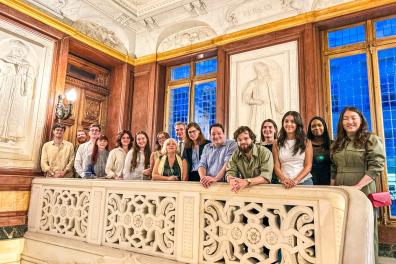
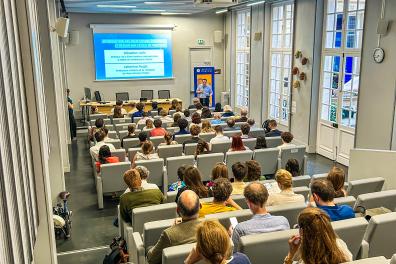
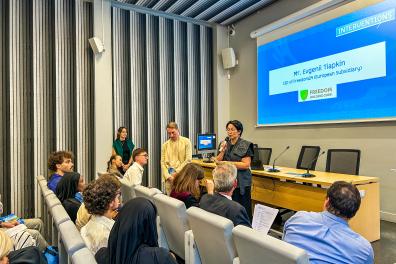
On Tuesday 29 September 2026, students from the first Central Asian International Relations Spring School shared their experiences at Inalco’s Research Centre, in front of friends, lecturers, partners and diplomatic representatives. This presentation evening provided an opportunity to look back on the highlights of their stay in Kazakhstan, whilst already paving the way for a second edition.
The institutions reaffirm their support
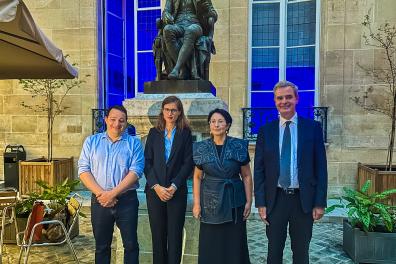
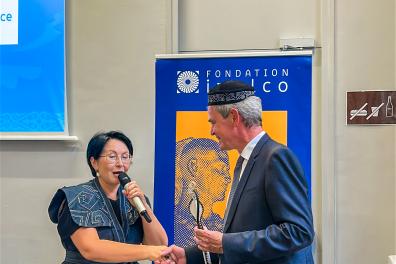
Several institutional representatives opened the evening: Delphine Allès, acting director of INALCO, Hubert Bazin, president of the INALCO Foundation, H.E. Ms Gulsara Arystankulova, Kazakhstan’s Ambassador to France, and H.E. Mr Sylvain Guiaugué, France’s Ambassador to Kazakhstan.
They all highlighted Central Asia’s growing role in international affairs and the importance of educating students capable of understanding the region’s realities from within.
The Ambassador of Kazakhstan to France praised a programme that ranks among “ those projects that represent a major investment in the future of Kazakhstan’s relationship with France ”. She emphasised that learning Kazakh means gaining an insight into a country through: “&its geography, its economy and its diplomacy ”, but also to discover “the language of a modern society, its literature and its media ”.&
To illustrate her point, she quoted the linguist, Turkologist and ethnographer Vasily Radlov, who, as early as 1870, had already ranked Kazakh amongst the world’s great languages for “ the richness of its vocabulary, the flexibility of its expression, and its depth ». - A monumental preface to Volume III of the work Образцы народной литературы тюркских племён (Specimens of the Folk Literature of the Turkic Tribes).
Mr Evgenii Tiapkin, Executive Director of Freedom24, emphasised the practical significance of the programme : France can thus count on future specialists and professionals who know the country through direct, on-the-ground experience.
“France could gain future specialists and professionals who know the country from first-hand experience. ” – Evgenii Tiapkin.
It should be noted that this first Spring School arose from the visit by President Tokayev to INALCO in 2022. It took place from 22 April to 3 May 2026, under the academic supervision of Catherine Poujol and Sébastien Colin, in partnership with the Sorbonne-Kazakhstan Institute and the IFEAC.
Five students, five perspectives on Central Asia
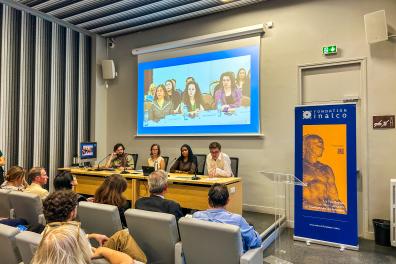
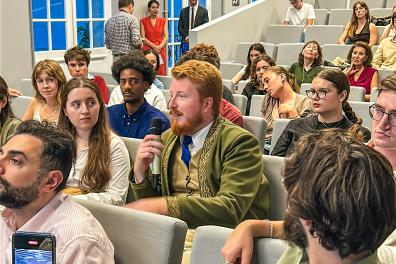
This was the highlight of the evening. One by one, the students described how eleven days in the field had changed their perspective on the region.
Throughout the programme, the days alternated between academic lectures, meetings with professionals and institutional representatives, academic exchanges and fieldwork. What made the biggest impression on them? The lectures delivered on site by academics, experts and diplomats, covering topics ranging from the new Kazakh Constitution to water issues, and from the energy transition to artificial intelligence. But also the discussions with Kazakh teachers and young people, which provided a different perspective, enabling them to discover and understand a generation that sees its future in its own country.
Throughout their stay, they worked in groups to summarise the day’s lectures and then draw connections between the topics covered. This work has now been compiled into a report booklet, featuring summaries of the lectures and five analyses written by the students at the end of the programme:
- Analysis No. 1 – Kyrgyzstan – Kazakhstan: A comparative analysis - Élise Cartagena, Léna Chery and Marie-Sana Singh
- Analysis No. 2 - Linguistic Dynamics in Kazakhstan: Between the Russian-speaking Community, National Identity and Multilingualism - Édith George, Vladimir Klein and Ismaël Ricard
- Analysis No. 3 - Tengirism in Central Asia: to what extent does the revival of Tengirism in Kazakhstan and Kyrgyzstan reflect a post-Soviet re-formation of identity? - Clémence Blanchard, Agathe Mallegol and Haby Sarr
- Analysis No. 4 - The role of civil society in Kazakhstan - Elma Duval and Ariane Monceau
- Analysis No. 5 - Alataou, ‘Smart Silk Road City’, a city of the future in Kazakhstan - Laura Leclerc, Romain Legros and Kilian Roux
The diversity of topics clearly illustrates the breadth of the perspective developed on the ground.
“The Spring School at the Sorbonne-Kazakhstan Institute was a rich and inspiring experience that I shall not forget in a hurry. The various lectures, as well as the discussions with Kazakh students, were particularly memorable and offered us a unique opportunity to immerse ourselves in the socio-political landscape of Central Asia, deepening our understanding of the region’s key challenges. It was a remarkable opportunity for learning and dialogue in an intellectually stimulating environment. I am also very proud to have taken part in this first edition, made possible thanks to INALCO, the INALCO Foundation and all the sponsors and partners. ” - Haby Sarr, M2 International Relations
She stayed: a prolonged immersion
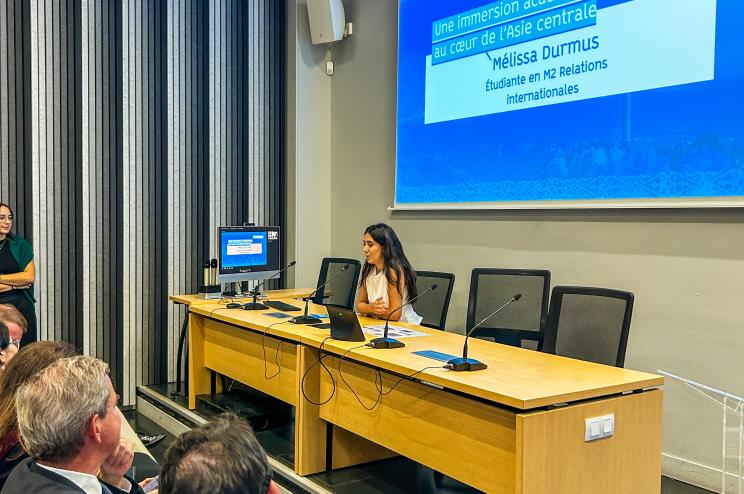
For one of the students, eleven days were not enough. Mélissa Durmus, a Master’s student in International Relations at INALCO, was lucky enough to be able to stay on for a few more months to continue her studies at the Sorbonne-Kazakhtsan Institute (ISK) in Almaty. She told us about her life there, living at the country’s own pace: the classes, the friendships, the shows and cultural performances, the Kazakh words that just come to mind, and that moment when you stop feeling like a visitor.
Her journey shows what the Spring School programme can offer: a genuine immersion, going beyond mere travel. And, we hope, it will inspire future students to take the plunge themselves.
How about a second one?
Fifteen students have paved the way. From Bishkek to Almaty, the route has been mapped out. It remains to be seen who will follow in their footsteps next time. More students, more encounters, and the same ambition to gain a deeper understanding of Central Asia. The Inalco Foundation intends to continue this adventure and help make the next edition possible. We’ll keep you informed of the next steps!
Thank you to our partners
This first edition would not have taken place without the commitment of the French Embassy in Kazakhstan and the Kazakh Embassy in France, the Sorbonne-Kazakhstan Institute and IFEAC.
Thanks also to Freedom Holding, a major partner of the programme, as well as to Verny Capital, TotalEnergies Renouvelables, Air Liquide and Veolia.
Thanks to high-level institutional and diplomatic figures
We would also like to extend our sincere thanks to all the institutional and diplomatic figures who spoke and took part in the discussions during this feedback evening :
- H.E. Ms Gulsara Arystankulova, Ambassador of the Republic of Kazakhstan to France
- H.E. Mr Sylvain Guiaugué, French Ambassador to Kazakhstan
- Mr Evgenii Tiapkin, CEO of Freedom24 (European Subsidiary)
- Mr Sébastien Colin, Head of the International Relations Programme and Senior Lecturer at INALCO
- Catherine Poujol, Professor of Central Asian History and Civilisation at INALCO
Take a look at the report booklet!
Livret de restitution de l'École de Printemps en Asie Centrale (3.92 MB, .pdf)
Fondation Inalco © Fondation Inalco