
Gao Qipei’s ‘The Tiger’ returns to Rue de Lille: a work saved, a legacy passed on
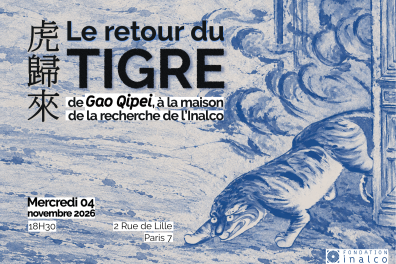
A little-known treasure of the O’ languages
For over a century, 2 Rue de Lille has been home to a precious part of the history of the O’ Languages. At the heart of this historic building, INALCO’s heritage collections bear witness to the wealth of intellectual, artistic and cultural exchanges that have accompanied the teaching of world languages and civilisations since the institute’s foundation in 1795.
Among these treasures is a unique work: The Tiger, painted in the early 18th century by Gao Qipei (1660–1734), a Chinese artist of the Qing dynasty, renowned for his mastery of finger painting.
Abandoning the brush to work directly with his fingers and fingernails, Gao Qipei developed a particularly free and expressive approach to Chinese literati painting. Far more than a technical feat, this practice reflects an original conception of the artistic gesture, in which the body itself becomes an instrument of creation.
Housed in the collections of INALCO, The Tiger thus constitutes a valuable testament to this pictorial tradition and, more broadly, to the diversity of artistic heritage that the institution helps to promote.
From Rue de Lille to Rue de Lille: a collective adventure
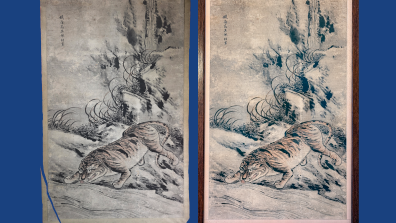
But over the centuries, the passage of time had weakened the work, making intervention necessary to ensure its preservation.
In March 2026, the Inalco Foundation decided to make its restoration much more than simply a preservation project: an invitation to rediscover the heritage of the O’ languages and to play a part, collectively, in passing it on.
On 24 March, an inaugural event symbolically marked the Tiger’s departure for several months of restoration. Donors, art lovers and friends of Inalco were invited to learn about the history of this painting and the challenges involved in its preservation.
Thanks to the generosity of the donors who rallied behind this project, The Tiger was entrusted to Camille Schmitt, a restorer specialising in Far Eastern artworks and a former student of the O’ Languages.
Having trained in particular in workshops specialising in the restoration of Chinese paintings and calligraphy, Camille Schmitt devoted several months to this work, drawing on specific expertise and an in-depth knowledge of Chinese conservation traditions.
Throughout this process, the Inalco Foundation sought to bring the project to life beyond the restoration workshop. The Carnets du Tigre, published over the course of several months, provided an opportunity to share the stages of this restoration whilst exploring the cultural and artistic world of the work: brushless painting, depictions of the tiger in Chinese traditions, Taoism, the history of the Qing dynasty and restoration techniques.
This approach turned the preservation of a painting into a genuine adventure of discovery and the passing on of knowledge.
On 4 November, the Tiger regains its place
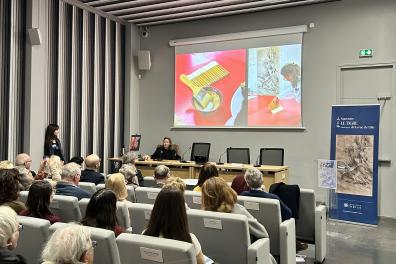
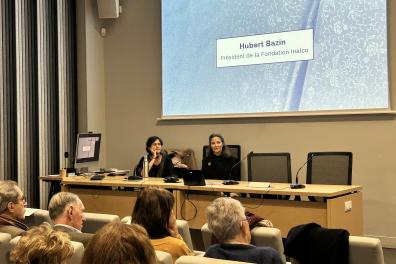
On Wednesday 4 November 2026, Inalco’s Maison de la recherche hosted an evening event to celebrate the return of the artwork, bringing together those who had been part of this journey.
Following a welcome address by Hubert Bazin, President of the Inalco Foundation, Camille Schmitt reviewed the various stages of the restoration, shedding light on the techniques and methods required to preserve an ancient Chinese painting.
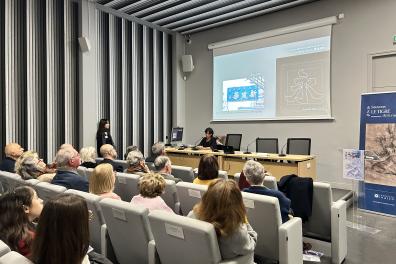
The evening continued with a lecture by Lia Wei, senior lecturer in Chinese art history at Inalco and researcher at the French Institute for Research on East Asia (IFRAE).
Entitled ‘Abandoning the brush: Materiality and Modernity in Calligraphy from the 18th Century Onwards”, her talk placed Gao Qipei’s work within the broader history of Chinese artistic experimentation, exploring practices that reinvent the tools, media and techniques of writing and painting.
The highlight of the evening was the unveiling of the restored Tiger in the Silvestre de Sacy Salon, marking its return to INALCO’s historical heritage after several months’ absence.
Preserving works of art, keeping knowledge alive
Beyond the restoration of a painting, the return of *Le Tigre* illustrates the importance of preserving and promoting INALCO’s heritage collections.
These works are not merely witnesses to the past: they serve as vehicles for knowledge, research and dialogue between cultures. Their conservation helps to keep alive the link between tangible heritage and the transmission of knowledge, which lies at the heart of the mission of the O’ Languages.
By bringing together donors, researchers, specialists and enthusiasts around *The Tiger*, the Inalco Foundation sought to emphasise that the preservation of heritage is a collective responsibility, but also a wonderful opportunity for sharing and discovery.
The Inalco Foundation extends its sincerest thanks to all the donors who contributed to this restoration, as well as to everyone who accompanied the Tiger on its journey.
From Rue de Lille to Rue de Lille, the Tiger has returned to its rightful place. Thanks to this collective effort, a precious part of the history of the ‘O’ Languages will continue to be viewed, studied and passed on to future generations.