The Minou Amir-Aslani Prize: five programme recipients honoured at the first awards ceremony
A partnership dedicated to Persian studies and the dissemination of knowledge
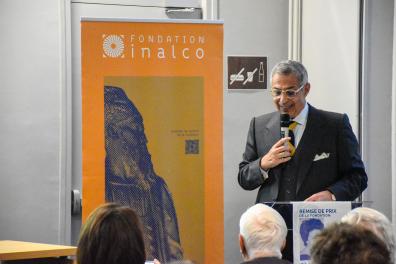
Opened by Hubert Bazin, President of the Inalco Foundation, and Maître Ardavan Amir-Aslani, founder of the Minou Amir-Aslani Foundation, this inaugural ceremony marks an important milestone in the implementation of the partnership agreed between the two foundations on 23 October 2025.
Established for a period of five years, this collaboration is based on a shared ambition: to support Persian studies and research on the Iranian world, to support students and researchers at various stages of their academic journey, and to promote the transfer of knowledge.
This partnership is particularly well-established at INALCO, where Persian has been one of the four languages taught since the institution’s foundation in 1795. This long-standing tradition, championed in particular by leading figures such as Antoine-Isaac Silvestre de Sacy, Georges Dumézil and Henry Corbin, continues today through the teaching and research carried out, notably, within the CeRMI and the CERMOM.
In a context where access to fieldwork may be restricted, support for language training and research is of particular importance. The Programme for the Study of the Iranian Worlds addresses these challenges by combining language immersion grants, research grants, a doctoral prize and an annual academic conference.
This partnership also has a profoundly human and commemorative dimension. Established by Maître Ardavan Amir-Aslani in tribute to his mother, Minou Amir-Aslani (1935–2010), who had a particular affection for the arts and culture, the Foundation that bears her name continues to uphold this spirit today through its commitment to education, artistic creation and the transmission of knowledge. Its partnership with the Inalco Foundation forms part of this ongoing commitment, with one key aim: to ensure that the name of Minou Amir-Aslani continues to inspire and enlighten future generations, by supporting students and researchers in their studies.
Five recipients honoured at this first edition
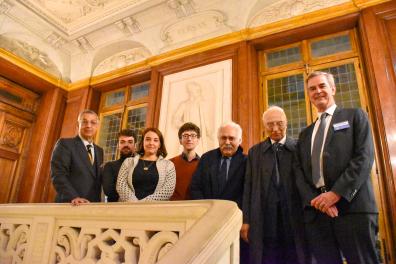
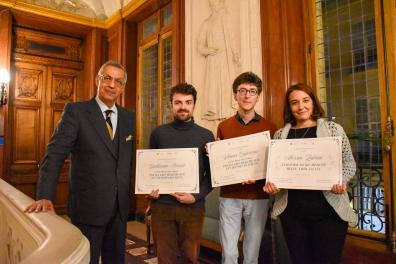
This inaugural ceremony highlighted five career paths illustrating the diversity of disciplines and approaches employed in the study of Iranian societies, ranging from language learning to political, intellectual and scientific history.
Language Immersion Scholarships – Zoé Zadegan and Liam Gentric
Zoé Zadegan and Liam Gentric, students of Persian at INALCO, are the first recipients of the programme’s language immersion grants.
Since September 2026, they have been continuing their studies in Tajikistan, at the Tajik National University in Dushanbe. This experience enables them to strengthen their language skills whilst immersed in a cultural and social environment directly linked to their studies.
Their video testimonials, presented during the ceremony, provided an opportunity to reflect on their experience and highlight the importance of immersion in deepening one’s command of a language and understanding of the societies in which it is spoken.
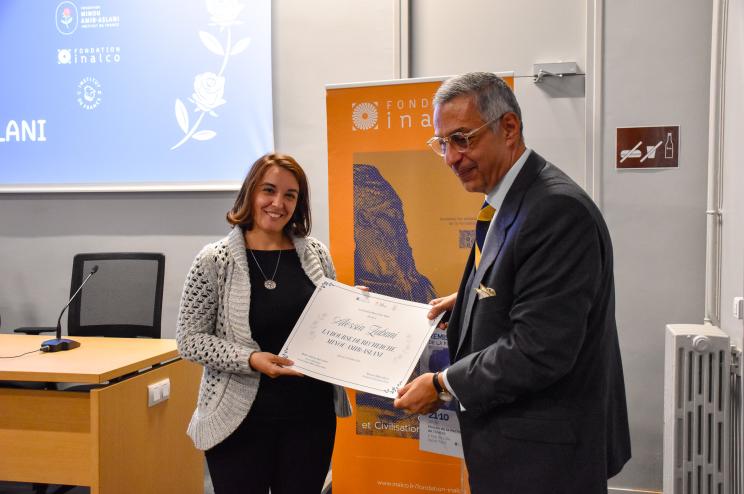
Research grant – Alessia Zubani
The research fellowship has been awarded to Alessia Zubani, a postdoctoral researcher at UCLouvain, whose work focuses on the history of technology and the circulation of knowledge in the medieval Islamic world.
Her research project, entitled ‘ Mechanics, court cultures and the dynamics of exchange between Anatolia and the medieval Iranian world”, focuses in particular on mechanical devices and ingenious machines, such as automata, moving statues and water clocks.
Through the study of these objects, she explores the links between technical innovation, material culture and the representation of power, as well as the exchange of knowledge between different regions of the medieval world.
Her research contributes to a better understanding of the role of scholars and craftsmen in the design, circulation and transmission of this technical knowledge.
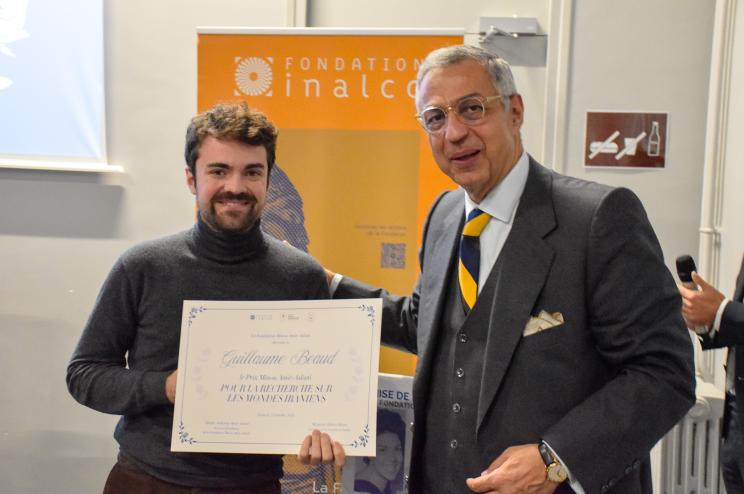
The Minou Amir-Aslani Prize for Research into Iranian Cultures – Guillaume Beaud and Wern
For this inaugural edition, the Minou Amir-Aslani Prize for Research on the Iranian Worlds has recognised two researchers for their doctoral theses, which focus on different periods and topics.
The winners were selected by the Scientific Interest Group on the Middle East and Muslim Worlds (GIS MOMM), placing this award within a scholarly context dedicated to the study of these regions.
Guillaume Beaud — State transformations in Iran and Pakistan
A postdoctoral researcher at the Free University of Brussels and a research associate at Sciences Po’s CERI, Guillaume Beaud was recognised for his thesis ‘Maintaining the State: Regime Change and the Overhaul of the Senior Civil Service in Iran and Pakistan’, which he defended in April 2025.
Through a comparative study of Iran and Pakistan, he analyses the transformations of public administrations following regime changes, as well as the relationships between political leaders and senior civil servants.
Based in particular on 140 interviews and extensive documentary research, his research examines how new political elites seek to reorganise the state apparatus and redefine the relationship between the government and the civil service.
His work thus contributes to a better understanding of the institutional and political dynamics in these two countries during the second half of the 20th century.
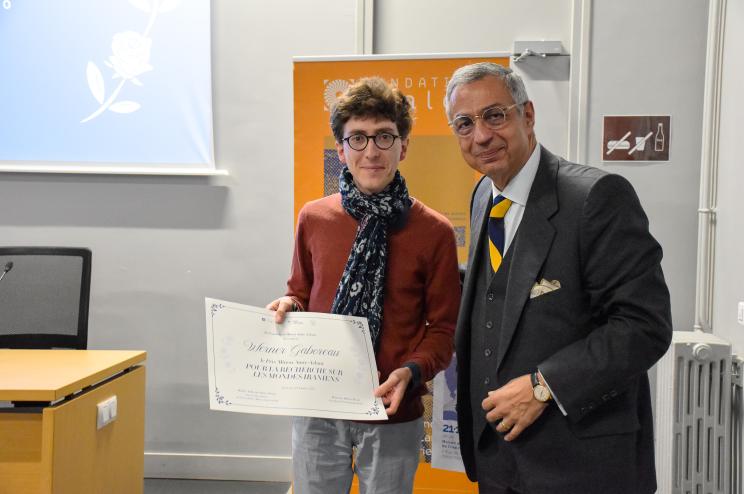
Werner Gaboreau — The exchange of knowledge between Safavid Iran and Europe
Historian and member of the École française de Rome, Werner Gaboreau was honoured for his thesis ‘ From the traveller’s eye to the eyes of scholars: the place of Safavid Iran in the globalisation of knowledge in the 17th century”, defended in December 2025.
His research focuses on the collection, circulation and transmission of knowledge between Safavid Iran and Europe in the early modern period.
By cross-referencing travel accounts, historical chronicles, dictionaries and scholarly sources from both Europe and Iran, he examines how European travellers and scholars gathered and interpreted the knowledge they encountered in Iran.
His work notably highlights the contribution of Arab-Persian knowledge to the development of European scholarship and provides a better understanding of the intellectual exchanges between these two regions in the 17th century.
An inaugural lecture by Professor Mohammad Ali Amir-Moezzi
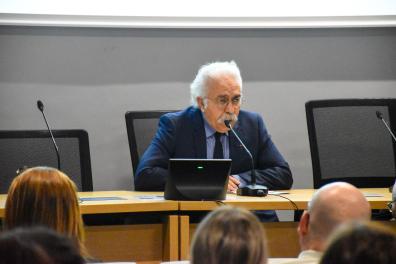
The evening also featured the inaugural lecture by Professor Mohammad Ali Amir-Moezzi, entitled ‘The Qur’an and the Prophet Muhammad: new scientific approaches’.
A leading figure in contemporary Islamic studies, Mohammad Ali Amir-Moezzi is Director of Studies Emeritus at the École pratique des hautes études (EPHE) and Chair of the Scientific Council of the French Institute of Islamic Studies. A graduate of INALCO, where he also taught Iranian civilisation, his work focuses in particular on the origins of Islam, Shi’ism, Qur’anic exegesis and the intellectual and spiritual traditions of the Iranian world.
His work has been recognised with the 2026 Avicenna Prize from the Royal Academy of Belgium.
In particular, he co-edited two major collective works: The Qur’an of Historians (2019), with Guillaume Dye, which was awarded the Grand Prix du livre by the Arab World Institute in 2020, and The Muhammad of Historians (2025), with John Tolan.
His lecture focused on the historical and scientific approaches that are contributing to a renewed understanding of the origins of Islam and its founding texts.
A commitment set to continue
This first edition marks an important milestone in the implementation of a programme designed to support students and researchers at various stages of their academic careers.
The Inalco Foundation would like to extend its warmest thanks to Maître Ardavan Amir-Aslani and the Minou Amir-Aslani Foundation, hosted by the Institut de France, for their trust and generous commitment to Persian studies and research into the Iranian world. Their support opens up new opportunities for students and early-career researchers, whilst contributing to the transmission and renewal of knowledge.
Beyond this inaugural edition, the two foundations wish to build on this momentum and rally further support for Persian studies, in order to enhance the opportunities available to future generations of students and researchers.