Journée d’études : "Le shaykh Akansūs et son temps. La spiritualité et les jalons de la Réforme"
Journée d’études organisée par Francesco Chiabotti (INALCO/CERMOM), Sophie Tyser (Université de Turin/CERMOM) et Michele Petrone (LUISS, Rome)
Dans le cadre du projet “MAG-Renew. Renouveaux spirituels et expressions artistiques dans le Maroc du 19ème siècle. Approches islamologique, littéraire et esthétique”, lauréat des projets d'excellence de l’Institut Français d’islamologie
Argumentaire
Le XIXème siècle représente un tournant majeur dans l’histoire du Maroc, marqué par une reconfiguration des champs politique, religieux et intellectuel, souvent associée à ce que l’historiographie désigne comme l’« époque de la nahḍa ». Pourtant, parallèlement à la nahḍa, une autre dynamique est à l’œuvre : celle d’un renouveau spirituel majeur, conduit par de nouvelles voies soufies (ṭuruq) qui émergent et se diffusent dans le Maghreb et l’Afrique subsaharienne à partir du Maroc. Parmi elles, la ṭarīqa tijāniyya occupe une place prépondérante. C’est dans ce contexte que s’inscrit la figure du savant Muḥammad Akansūs (m. 1294/1877), célèbre pour son activité politique, d’abord comme secrétaire (kātib) du sultan Moulay Sulaymān (r. 1792-1822), puis comme vizir durant les trois dernières années de son règne. Il est également connu comme historiographe de la dynastie alaouite, ainsi que comme homme de lettres distingué de son époque et linguiste, à l’origine d’une édition du Qāmūs al-muḥīṭ. Poète remarquable, il est aussi l’auteur d’une maqāma (« séance littéraire »). Il fut aussi et surtout un important savant en sciences religieuses de son temps, ainsi qu’un maître respecté au sein de la tijāniyya, à laquelle il s’affilie quelques années après la disparition du fondateur de la voie, le shaykh Aḥmad al-Tijānī (m. 1230/1815).
À travers l’étude de l’œuvre et le parcours d’Akansūs, cette journée d’études vise à explorer le rôle des principaux relais qui ont alimenté le renouveau spirituel et intellectuel à la veille de l’irruption coloniale. Loin de se limiter à son rôle politique de conseiller des sultans, Akansūs fut un acteur privilégié de ce renouveau. En tant que savant et guide spirituel au sein de la tijāniyya, il fut le fondateur de la première zāwiya de cette voie à Marrakech, à partir de laquelle elle s’étendit vers les montagnes de l’Atlas, la région de Souss et au-delà encore. Il fut par ailleurs fortement impliqué dans les débats spirituels (concernant notamment la légitimité de la tijāniyya) et religieux de son époque. Akansūs fut également un acteur notable du renouveau intellectuel de son temps. Son intérêt pour des sciences telles que les mathématiques, l’astronomie et la médecine reflète une curiosité intellectuelle qui l’a aussi conduit à explorer les avancées des sciences occidentales de l’époque via la supervision de la traduction d’ouvrages scientifiques – mathématiques et astronomiques –, du français et de l’anglais, conservés à la Bibliothèque royale de Rabat.
Cette journée d’étude se propose ainsi d’approfondir l’étude du parcours singulier d’Akansūs, et d’explorer son héritage dans sa pluralité : historiographe de la dynastie alaouite et témoin des conflits entre le Maroc et les puissances occidentales, mais aussi lettré, savant et maître spirituel, son œuvre porte un témoignage précieux sur les transformations politique, intellectuelle et spirituelle qui surviennent durant ce que l’on appelle l’ère de la réforme (zamān al-iṣlāḥ). Akansūs joue aussi un rôle dans la circulation des savoirs entre le Maghreb et l’Afrique subsaharienne (et même au-delà), où la tijāniyya connaît une expansion majeure. Ce colloque sera également l’occasion de faire le bilan des recherches académiques concernant la tijāniyya, parfois encore étudiée indépendamment de son enracinement maghrébin. En révélant la richesse de l’héritage du shaykh Akansūs et son rôle dans les évolutions du soufisme à la fois locale et internationale, ce colloque vise en définitive à redonner sa juste place au renouveau spirituel et intellectuel qu’a connu le Maroc au XIXème siècle.
∴
The 19th century represents a major turning point in the history of Morocco, marked by a reconfiguration of the political, religious, and intellectual fields, often associated with what historiography designates as the ‘era of the nahḍa.’ Yet, parallel to the nahḍa, another dynamic was at work: that of a major spiritual renewal, led by new Sufi orders (ṭuruq) that emerged and spread throughout the Maghreb and Sub-Saharan Africa from Morocco.
Among them, the ṭarīqa tijāniyya occupies a preponderant place. It is within this context that the figure of the scholar Muḥammad Akansūs (d. 1294/1877) belongs. He is celebrated for his political activity, first as secretary (kātib) to Sultan Moulay Sulaymān (r. 1792-1822), and then as vizier during the final three years of his reign. He is also known as an historiographer of the Alawite dynasty, a distinguished man of letters of his time, and a linguist responsible for an edition of the Qāmūs al-muḥīṭ. A remarkable poet, he was also the author of a maqāma (“literary session”). Above all, he was an important scholar in religious sciences and a respected master within the tijāniyya, which he joined a few years after the passing of its founder, Shaykh Aḥmad al-Tijānī (d. 1230/1815).
Through the study of Akansūs’s work and career, this colloquium aims to explore the role of the primary conduits that fueled the spiritual and intellectual renewal on the eve of the colonial incursion. Far from being limited to his political role as a counselor to sultans, Akansūs was a privileged actor in this renewal. As a scholar and spiritual guide within the tijāniyya, he founded the first zāwiya of this order in Marrakech, which served as a starting point for its extension toward the Atlas Mountains, the Souss region, and beyond. He was furthermore heavily involved in the spiritual (concerning the legitimacy of the tijāniyya) and religious (polemics with the salafiyya) debates of his era.
Akansūs was also a notable participant in the intellectual renewal of the period. His interest in sciences such as mathematics, astronomy, and medicine reflects an intellectual curiosity that led him to explore Western scientific advancements by supervising the translation of French and English works—now preserved in the Royal Library in Rabat.
This colloquium proposes to deepen the study of Akansūs’s singular career and explore his legacy in its plurality. As an historiographer of the Alawite dynasty and witness to conflicts between Morocco and Western powers, but also as a man of letters, scholar, and spiritual master, his work provides precious testimony to the political, intellectual, and spiritual transformations occurring during the “era of reform” (zamān al-iṣlāḥ). Furthermore, Akansūs played a role in the circulation of knowledge between the Maghreb and Sub-Saharan Africa, where the tijāniyya experienced major expansion.
Finally, this colloquium will be an opportunity to take stock of academic research regarding the tijāniyya, which is sometimes still studied independently of its Maghrebi roots. By revealing the richness of Shaykh Akansūs’s legacy and his role in local and international Sufi evolutions, this event ultimately aims to restore the spiritual and intellectual renewal experienced by 19th-century Morocco to its rightful place.
Programme
9h-10h :
- Sophie Tyser (INALCO/CERMOM), De l’ikhtilāf al-madhāhib à l’ikhtilāf al-ṭuruq : droit, soufisme et pluralisme selon Muḥammad Akansūs.
- Natalie Kraneiß (University of Münster), From Commentary Back to Collation? Philological Practices around al-Qāmūs al-Muḥīṭ in 19th-Century Morocco.
- Yaseen Christian Andrewsen (University of Oxford, Faculty of Theology and Religion), Revisiting the Intellectual Basis of a Sufi Dispute: Aḥmad al-Bakkāy al-Kuntī, Muḥammad Akansūs, and the Epistemological Stakes of the Qādirī–Tijānī Exchange.
10h-10h20 : questions et échange
Pause café
10h30-11h30 :
- Pierre Ageron (Université de Caen), Deux aventures éditoriales de sciences exactes dans le Maroc du XIXe siècle.
- Michele Petrone (LUISS, Rome), The zāwiya Saʻīdiyya in Ethiopia. Sukayrijī kunnāsh
- Francesco Chiabotti (INALCO/CERMOM), Notes sur le poème de fondation de la zāwiya kansūsiyya à Marrakech.
11h30-12h : questions et échange
12h30 : Conclusion (Francesco Chiabotti, Michele Petrone et Sophie Tyser)
Pause déjeuner pour les participants
14h-15h30 : Rencontre avec Jaafar Kansoussi et Mohamed Mehdi Kansoussi (discutant : Antoine Perrier, CNRS, CHS).
15h30 : Pause café
16h-17h : Réunion de travail au CERMOM
Résumés des interventions
Pierre Ageron (Université de Caen), “Deux aventures éditoriales de sciences exactes dans le Maroc du XIXe siècle”
Cette communication mettra en lumière les efforts de renouveau scientifique qu'a connus le Maroc au XIXe siècle à travers deux initiatives ambitieuses du pouvoir chérifien : la traduction du français à l'arabe de la très ample Astronomie de Lalande (achevée en 1852) et la lithographie d'une rédaction (Taḥrīr) des Éléments d'Euclide attribuée (à tort) à Naṣīr al‐dīn al‐Ṭūsī (achevée en 1876).
Je préciserai le contexte, le but et les suites de ces entreprises, et mettrai l'accent sur leurs acteurs – dont Akansūs – et leurs aspects matériels. Je sortirai de son isolement la lithographie de 1876 en présentant pour la première fois deux manuscrits marocains contenant le même texte : une copie d'apparat royale et une copie d'étude découverte à Taroudant.
J'approfondirai enfin les stratégies de légitimation propres à chacun des deux projets. La traduction de l'Astronomie, œuvre d'un infidèle, fut déclarée licite en s'appuyant sur les avis de juristes influents au sein de confréries soufies du Maghreb médiéval. L'édition du Taḥrīr des Éléments d'Euclide ne nécessitait pas de traduction, mais posait une difficulté, car elle était en réalité copiée sur un ouvrage imprimé en caractères arabes à Rome en 1594, dont elle corrigeait cependant les erreurs typographiques. Pour masquer cette origine embarrassante, ses promoteurs préférèrent attribuer les erreurs à de prétendues traductions défectueuses du turc vers l'arabe.
The 19th century represents a major turning point in the history of Morocco, marked by a reconfiguration of the political, religious, and intellectual fields, often associated with what historiography designates as the “era of the nahḍa.” Yet, parallel to the nahḍa, another dynamic was at work: that of a major spiritual renewal, led by new Sufi orders (ṭuruq) that emerged and spread throughout the Maghreb and Sub-Saharan Africa from Morocco.
Yaseen Christian Andrewsen (University of Oxford, Faculty of Theology and Religion), “Revisiting the Intellectual Basis of a Sufi Dispute: Aḥmad al-Bakkāy al-Kuntī, Muḥammad Akansūs, and the Epistemological Stakes of the Qādirī–Tijānī Exchange”
Socio-political dimensions of the mid-nineteenth-century dispute between Aḥmad al-Bakkāy al-Kuntī (d. 1281/1865), the foremost guide of the Qādirī path in the Sahara and Sahel, and Muḥammad Akansūs (d. 1294/1877), a prominent guide of the Tijānī path in the Maghreb, have received some attention in existing scholarship. Yet the intellectual substance of their exchange—preserved in al-Bakkāy’s Fatḥ al-Quddūs fī’l-radd ʿalá Akansūs and the latter’s Jawāb al-muskit—remains under-examined. This paper offers a preliminary exploration of the intellectual stakes underlying their exchange. Following from my work on al-Bakkāy’s grandfather, al-Mukhtār ibn Aḥmad al-Kuntī (d. 1226/1811), I consider the epistemological and theological grounds on which the Kunta objected to their Tijānī counterparts. I argue that the dispute cannot be adequately understood without taking those grounds seriously on their own terms. The paper thus contributes to a broader reassessment of Sahelian and Maghrebi intellectual culture in the nineteenth century, attentive to paradigmatic commitments that shaped Sufi discourses and disagreements across the region.
Francesco Chiabotti (INALCO/CERMOM), “Notes sur le poème de fondation de la zāwiya kansūsiyya à Marrakech”
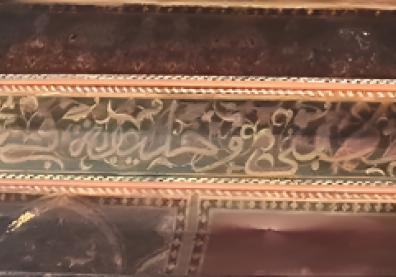
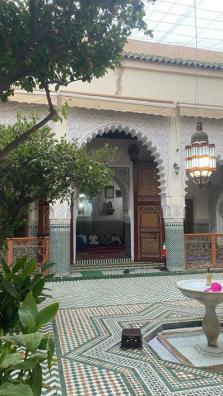
Le XIXe siècle marocain constitue une période d'une grande richesse en sources épigraphiques issues des milieux soufis, dont la zāwiya Kansūsiyya offre un exemple remarquable. Elle abrite une frise peinte sur bois reproduisant le poème composé par le shaykh Akansūs lors de la fondation de l'édifice en 1847, au sein du quartier Mouassine. Cette présentation exposera les images de cette frise, proposera une édition ainsi qu'une traduction du texte, et abordera les enjeux de conservation de la médina de Marrakech, particulièrement au lendemain du séisme de 2023.
Natalie Kraneiß (University of Münster), “From Commentary Back to Collation? Philological Practices around al-Qāmūs al-Muḥīṭ in 19th-Century Morocco”
Why did Muḥammad Akansūs (d. 1294/1877) undertake a new collation—described in
modern scholarship as taḥqīq—of al-Fīrūzābādī’s al-Qāmūs al-Muḥīṭ in the mid-nineteenth century, despite the existence of extensive commentaries, most notably al-Zabīdī’s Tāj al-ʿarūs? This paper presents preliminary findings from an ongoing investigation into the philological practices surrounding the Qāmūs and explores how Akansūs’ work may be situated within a longer Moroccan tradition of textual scholarship. Rather than approaching Akansūs’ collation in isolation, the paper first examines selected passages from the commentaries of Ibn al-Ṭayyib al-Fāsī (d. 1170/1756) and his student al-Zabīdī (d. 1205/1791). These reveal a highly developed philological practice, in which lexical explanation is closely intertwined with the comparison of manuscripts, the evaluation of variant readings, the identification of scribal errors (taṣḥīf), and explicit discussions of textual authority. Against this background, Akansūs’ decision to prepare a collation of the Qāmūs—reportedly on the basis of more than fifty manuscripts—raises the question why, after centuries of extensive commentarial engagement with the text, a renewed effort was devoted to establishing its textual basis. Building on these observations, the paper offers a first exploration of Akansūs’ annotated manuscript of the Qāmūs. As the manuscript evidence is still under investigation, it asks what precisely Akansūs’ collation (taṣḥīḥ) consisted of, how it related to the long-standing commentary tradition surrounding the Qāmūs, and in what ways it may be situated in relation to what later scholarship came to describe as taḥqīq.
Michele Petrone (LUISS, Rome), The zāwiya Saʻīdiyya in Ethiopia. Sukayrijī kunnāsh
Tijāniyya has been present in Ethiopia since the beginning of the 20th century, gaining a particular momentum from the mif 1930's with the arrival of al-Faqīh Aḥmad b. ʻUmar (d. 1953) from Sudan. The latter had the merit to spread the order in Western Ethiopia, from Belashangul-Gumuz to Jimma. Several collections of Tijānī zawāya have been identified in the area, preserving manuscripts that hold text from both local and foreign authors. In the collection of Abba Jamaal (Jimata, 60 Km North of Jimma) is preserved a number of texts belonging to the tradition of the Maghreb. Among them a previously unidentified collection of arājīz by Aḥmad Sukayrij (d. 1944) have been copied in a kunnāsh by the local Tijānī master. Two of them, one dealing with al-Jawāb al-muskit and one with the resumption of activities of the Saʻīdiyya zāwiya in Marrakesh, are the only ones highlighted with specific annotations. This paper will focus specifically on the second urjūza that, apparently, has very little to do with the ṭarīqa in Ethiopia. It will argue that Sukayrij’s discussion of the paradigmatic attitude of the members of the ṭarīqa in Marrakesh, facing the political and administrative turmoils of 1915, may have served as a model for what was happening in Ethiopia under Italian occupation (1936–42). By examining the text alongside its marginalia, scribal glosses, and historical context, this paper demonstrates how the urjūza served not merely as a devotional recollection, but as an operative paradigm for Sufi resilience. The Zāwiya Saʻīdiyya in Marrakesh represented a historic precedent for preserving spiritual authority and institutional integrity amidst state interference and political crisis. Sukayrij’s account of how the Marrakeshi Tijānīs navigated the administrative disruptions of 1915 offered a timely playbook for the Tijānī leadership in Western Ethiopia as they faced the violent of the Italian occupation (1936–1942). This presentation argues that the deliberate selection of this specific poem in the Jimata kunnāsh reflects an active appropriation of Akansūsian institutional memory. Rather than a passive reception of North African history, the Ethiopian copyist weaponized the Marrakeshi precedent to legitimize local strategies of survival.
Sophie Tyser (INALCO/CERMOM), “De l’ikhtilāf al-madhāhib à l’ikhtilāf al-ṭuruq : droit, soufisme et pluralisme selon Muḥammad Akansūs”
Cette communication se propose de mettre en lumière la convergence entre le pluralisme juridique et le pluralisme spirituel chez Muḥammad Akansūs (m. 1877). S’inscrivant dans la tradition du « soufisme juridique » illustrée par de grands maîtres tels qu’Aḥmad Zarrūq ou ʿAbd al-Wahhāb al-Shaʿrānī, Akansūs étaye une vision où la jurisprudence et le soufisme apparaissent comme indissociables. En nous appuyant sur l’analyse de deux écrits en particulier – la Muqaddima des Ḥulal al-zanjafūriyya et surtout sa risāla inédite sur l’ikhtilāf al-madhāhib et l’ikhtilāf al-ṭuruq –, nous tenterons de montrer comment il transpose le principe juridique kull mujtahid muṣīb (« tout mujtahid a raison ») au domaine spirituel, pour légitimer la diversité des voies soufies (ikhtilāf al-ṭuruq) comme une manifestation de la Miséricorde divine. Cette étude vise ainsi à explorer les interfaces entre soufisme et raisonnement juridique, en montrant comment le pluralisme juridique devient chez Akansūs un modèle pour concevoir la diversité des voies spirituelles.
Contact: View e-mail