Nicolas Cavaillès, winner of the 2026 Inalco-Vo/Vf Translation Prize
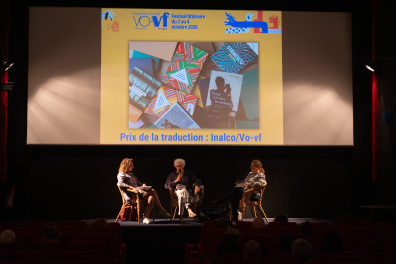
The prize was presented on Sunday 4 October during the Vo-Vf festival by Rose Labourie, a translator from German and director of the École de traduction littéraire, in the presence of the prize’s founders, Nathalie Carré and Marie Vrinat-Nikolov (Inalco).
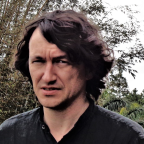
Born in 1981, Nicolas Cavaillès has translated some of the greatest voices in Romanian literature, including Constantin Acosmei, Gabriela Adameşteanu, Mircea Cărtărescu, Mihai Eminescu, Nicoleta Esinencu, Norman Manea, Ileana Mălăncioiu, Herta Müller, Bogdan-Alexandru Stănescu, Dumitru Tsepeneag, Urmuz and Matei Vişniec. For the ‘Bibliothèque de la Pléiade’ (Gallimard), he edited the French works of Cioran (2011) and contributed to the edition of Philip Roth’s novels (vol. III, 2025). He is also the author of several short stories and works of fiction, notably Vie de monsieur Leguat (Éditions du Sonneur, 2013, Prix Goncourt de la Nouvelle), Pourquoi le saut des baleines (Éditions du Sonneur, 2015, Prix Gens de Mer), and Le Livre des Cellules (Corti, 2025).
Summary
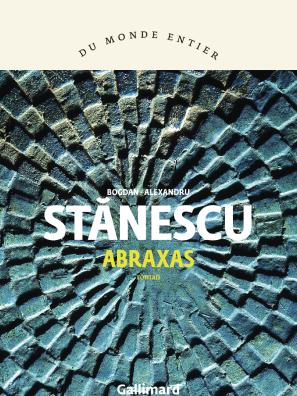
Mihai Lucescu, a history teacher with a nature that is both sombre and sentimental, is going through an existential crisis. Separated from his wife, he has left the family home and lives alone in the attic of an old house. To shake off his lethargy, he engages in a long period of self-reflection, delving into his neuroses and examining his downfall. Fascinated by mnemonics – that ancient art of linking a memory to a place – he sets about building a palace of memory. In this mental edifice, modelled on a Bucharest block of flats, eleven doors open onto as many of the city’s old cinemas.
Alternately a spectator and a protagonist in the films being screened, Mihai revisits key scenes from his life, whilst immersing himself in other eras and in places as varied as Vienna, Paris and New York. Intimate, formative scenes; figures from the Romanian diaspora; fragments of a collective past or of times to come – the films unfold, each one distinct from the next. Only the fascinating ‘House of Lions’ recurs like a refrain. It was there, in this almost organic building, guarded by two stone lions, that his mother reigned – a whimsical and overbearing artist from whom he will never quite break free.
With Abraxas, Bogdan-Alexandru Stănescu has crafted a masterful novel about memory and childhood, loss and survival, in which incisive prose unfolds, interwoven with visual and sensory flourishes. A dizzying inner panorama in which the evil and melancholy of the world are depicted with singular ingenuity, alongside a faith in the redemptive power of literature.
Nicolas Cavaillès has brilliantly risen to the many challenges presented by the original text. In particular, the translator has taken great care to preserve the work’s unique syntax – those long passages in which digressions multiply endlessly without the text ever losing its coherence. The translation captures the polyphony characteristic of the original version, as the narrator’s voice is joined, as the pages turn, by that of a 12th-century monk, that of a surrealist poet’s rival in the Paris of the Roaring Twenties, and that of the mistress of an American poet from the interwar period…
Rose Labourie, Director of the École de traduction littéraire and a member of the Translation Prize jury
The oral quality so dear to Bogdan-Alexandru Stănescu is skilfully rendered by Nicolas Cavaillès through the alternation of registers and the use of slang. Faced with a wealth of political, cultural and artistic references, the translator has made the judicious choice to occasionally include explanatory parenthetical notes or footnotes. It is also these notes that allow him to retain certain typically Romanian terms, such as street names, place names and culinary specialities, which are neither translated nor adapted into French.
The expert review praises the ‘creative, meticulous and subtle work of Nicolas Cavaillès, who brings out the distinctiveness of the Romanian language whilst managing to guide the reader where necessary’.
The Inalco Translation Prize – Vo/Vf Festival
With a prize fund of 2,500 euros, this award is intended to highlight the quality of a translator’s work, as well as the richness of literary works that are sometimes still little known to the general public, as they are often less widely distributed. Eligible for this competition are prose works (short stories or novels) published within the three years preceding the award ceremony. Works translated by members or students of Inalco are not eligible.
Through this initiative, Inalco aims to highlight its expertise in the field of translation, whilst also recognising the work of translators and their publishers in fostering dialogue between the world’s literatures.