Inalco student prize for manga: discover the shortlist and the 2026 jury
The winning title will be unveiled on Wednesday June 3, 2026 at a prize-giving ceremony at the Musée Guimet, and will receive an endowment of 2,500 euros from the museum.
The Émile Guimet Prize for Asian Literature
9th Émile Guimet Prize for Asian Literature
This prize, created to highlight the richness and diversity of Asian literature translated into French, enters its ninth edition with a selection of outstanding works. Launched by the musée Guimet in 2017, it distinguishes, under the presidency of Laure Adler, the original work of an author from Asia, recently translated and published in France. It aims to promote contemporary Asian literature and encourage cultural exchanges between Asia and France. The Prix Émile Guimet de littérature asiatique crowns a work in three categories: "Roman", "Comics" (a category created in 2024) and "Manga" (since 2025, in partnership with Inalco).
This prize is also a homage to translators, true passers of talent whose work is essential to enable book publishing in France and promote its knowledge.
The manga category
The Inalco Student Prize for Manga distinguishes a manga published in Japan and translated into French, as well as a coup de coeur distinction. The prize is intended to reward a voice and an approach that make a significant contribution to Japanese comics, while helping to promote auteur manga and introduce this vast universe to France.


Shortlisted books in the Manga category
- " The Invisible Wars " volume 1, Marina Lisa Komiya, éditions Casterman - translated by Anaïs Koechlin
- " Les nations du soleil sanglant " tome 1, Ikka Matsuki, éditions Akata - translated by Célia Chinarro
- " Sorcières " tome 1, Daisuke Igarashi, éditions Delcourt - translated by Anaïs Fourny
- " Mahoromi " tome 1, Kei Tōme, éditions Le Lézard noir - translated by Adrien Blouët
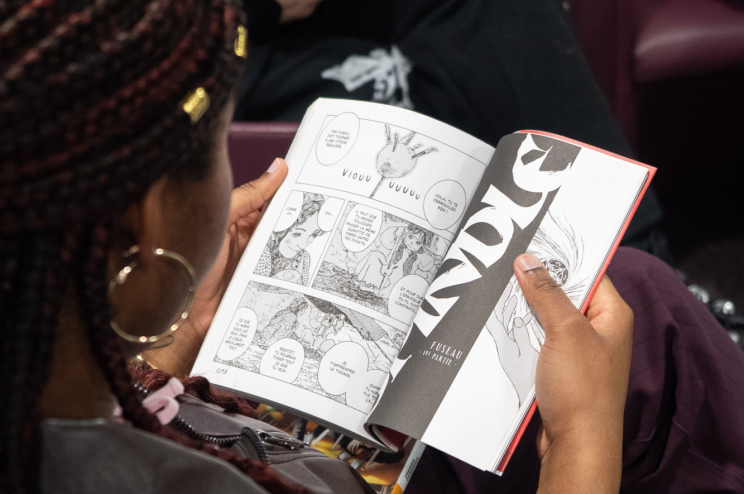
- " The Unspeakable", Gō Tanabe, éditions Ki-Oon - translated by Sylvain Chollet
- " Promenons nous dans l'espace " tome 1, Inuhiko Doronoda, éditions Glénat - translated by Karine Rupp Stanko
- " Sounds of vinyl " volume 1, Ryōichirō Kezuka, éditions Vega-Dupuis - translated by Satoko Fujimoto and Candice Corbeel
- " Le ballet des cœurs" tome 1, Haruka Kawachi, éditions Naban - translated by David Pollet
The 2026 jury of the Inalco Student Prize for Manga
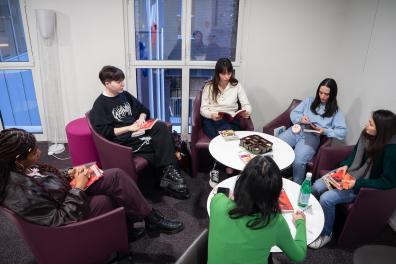
The jury is made up of five female students from different departments at Inalco.

Mona Chailleby - Licence 2 coréen
Student in 2ᵉ year of Korean at Inalco, Mona is particularly attached to seinen and narratives that favor nuance over explanation. She lived in Japan for two years, an experience that strengthened her sense of observation and attention to cultural and narrative detail. Having passed through the Human Academy, she is working on a personal visual novel project alongside her studies, which feeds her interest in the construction of realistic characters and a show, don't tell narrative, where mise-en-scene, rhythm and the unspoken carry meaning. She will pay particular attention to the psychological realism of characters and the way drawing tells without highlighting.

Prisca Sacko-Denis - Licence 2 chinois
After a general baccalaureate, a year in applied arts and currently in 2ᵉ year of Chinese at Inalco, she discovered manga at the age of 5 and grew up with it. Now studying Mandarin, it was her passion for Japan that was her gateway to different Asian cultures. She reads everything and is currently working on exploring myths in literature.

Nina Clément - Licence 1 japonais
Master's student in geography at Sorbonne Université, alongside her Japanese studies at Inalco, Nina Clément is developing research on French migrations to the Keihanshin region and experiences of inhabitation. A mobility at the University of Dōshisha (Kyōto) reinforced this orientation and her attention to the social and cultural dynamics of Kansai, echoing an older interest in Japan, initially born of her discovery of manga.
She is particularly attached to this medium for its ability to reach diverse audiences and to offer narratives that are both accessible and deeply rooted in specific cultural contexts. She has a particular interest in seinen and josei, which she appreciates for the diversity of registers they cover and for narratives that are often more nuanced, leaving plenty of room for ambivalence.

Erell Lucas - Master 1 Japanese
After graduating with a Bachelor's degree in graphic design, she followed her dream of becoming a translator and began a degree in Japanese at Inalco. A manga and anime enthusiast, she is president of the anime club in the Japanese Studies department, and also participated as a mediator in a nocturne for the exhibition "Manga. Tout un art!" at the Musée Guimet. Her research focuses on denpa-kei, an artistic style that would forge otaku culture in the 90s. She is also a manga illustrator.

Elise Leroy - Master 1 Japanese
Holder of a bachelor's degree in Japanese from Inalco and a bachelor's degree in art history and archaeology, majoring in prehistory, from Panthéon-Sorbonne 1, she is currently in the Master LLCER Japanese program. Her Master's subject deals with dogū, clay figurines from the Jōmon period (Japanese prehistory). She has an interest in these figurines from an archaeological, museum and artistic point of view, but also in their place in contemporary Japanese society, through pop culture and manga in particular. She has worked for several years as a French-Japanese interpreter at events such as Japan Expo and Art Shopping at the Carrousel du Louvre. Passionate about manga since she was a teenager, she owns a large collection in a wide variety of styles.